
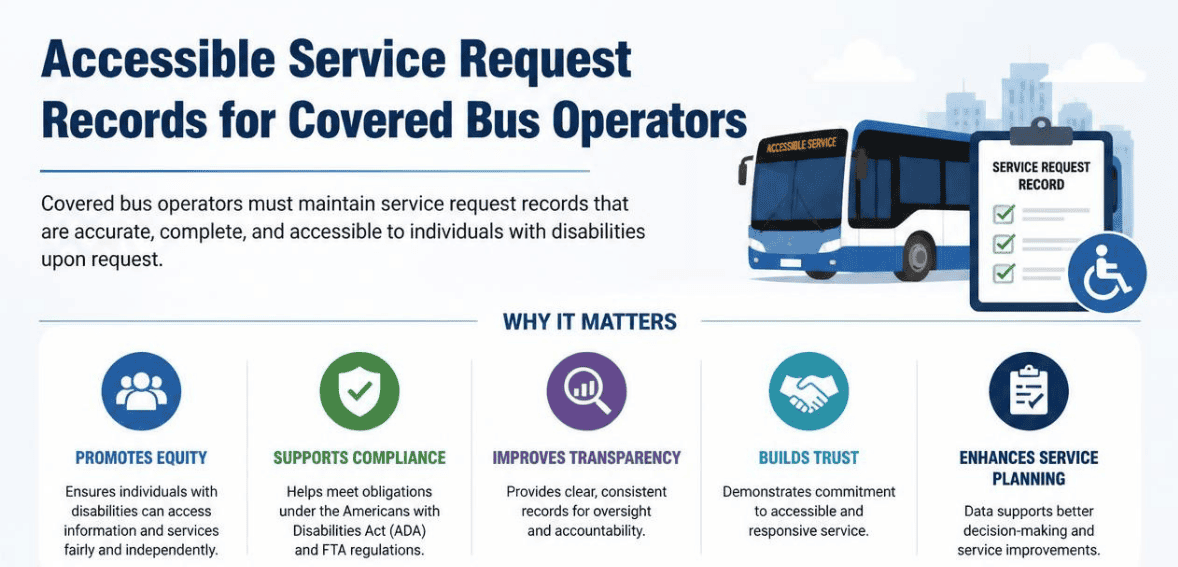
A passenger who uses a wheelchair calls your reservation line. She wants a seat on a motorcoach leaving in three days. From that moment, a clock starts ticking. You have until the end of the next business day to send her a confirmation. And you have five years to hold onto the paperwork.
The focus of this article is a series of forms. If you operate motorcoaches, you are likely a “covered” operator under the federal disability law. This means that you have a legal obligation to maintain accessible-service request records. Failure to comply with this law may lead to the filing of complaints, audits, and even civil penalties. On the other hand, if you correctly maintain these records, the process of compliance becomes routine.
This guide explains the requirements for the accessible service request records for over-the-road buses under the ADA. We will explain the records, who is obligated to maintain the records, the record form, the unexpected time deadlines, and the records retention time.
What Are Accessible Service Request Records?
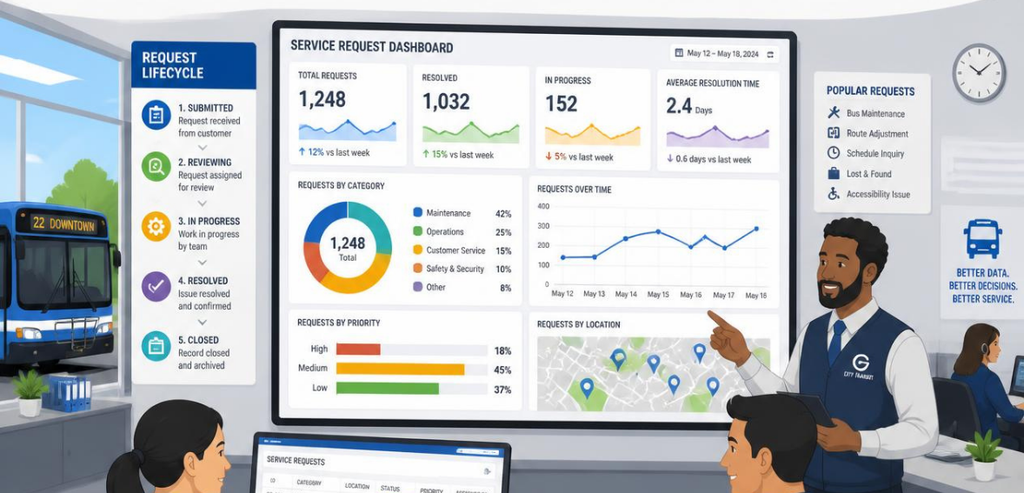
Accessible-service request records document every time a passenger with a disability asks for an accessible bus or equivalent service. They prove you received the request. They prove how you responded. And they prove whether the accessible trip actually happened.
These records fall under the Americans with Disabilities Act (ADA). The U.S. Department of Transportation developed these rules within 49 CFR Part 37, Subpart H. This subpart applies to private-sector over-the-road buses, or OTRBs.
An OTRB is a bus with an elevated passenger deck sitting over the cargo area. This is a motorcoach. If your buses look like this, then it is likely that Subpart H is applicable to you.
Who Counts as a “Covered” OTRB Operator?
Not every bus company is treated the same. The rules split operators into a few groups, and your group decides which records you keep.
Fixed-route operators run service at specified times along established stops. In contrast, demand-responsive operators, such as charter and tour companies, provide service upon request. Some demand-responsive and charter service operators may require up to 48 hours’ advance notice to coordinate an accessible bus. Fixed-route services cannot ask for flexible itinerary planning like many demand-responsive operators.
Size does matter. According to the feds, large operators have different obligations than small operators, and small operators began their obligations at different times. Some small operators, known as mixed-service operators, have some flexibility in how they meet their obligations. Small fixed-route operators are allowed by the regulations to provide equivalent service instead of providing an accessible bus for each route.
Equivalent service is relatively straightforward. It means service must be as good as offered to riders without disabilities, served at the same times, on the same days, for the same fare. A passenger must also be allowed to travel in their wheelchair. The operator must provide equivalent service if it cannot provide an accessible bus.
The Service Request Form (49 CFR Part 37, Appendix A)
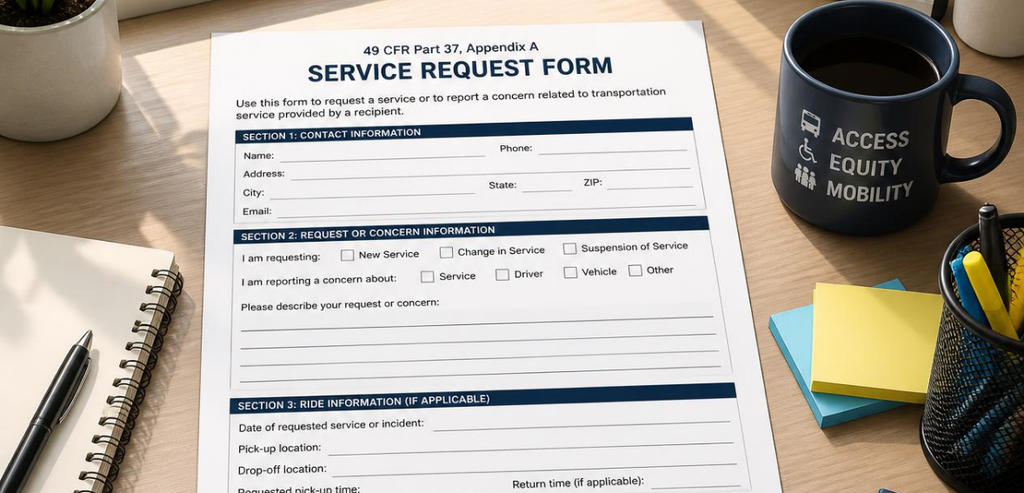
Here is the good news. You do not have to invent a form. The government already wrote one. It sits in Appendix A to Subpart H, and it is called the Service Request Form.
You complete lines 1 through 9 the moment a request arrives. Those lines capture the who, what, when, and where of the trip.
- Operator details: your company name, address, and phone number.
- Passenger details: the rider’s name, address, and phone number.
- Trip schedule: the dates and times of every leg of the trip.
- Request timestamp: the exact date and time the passenger asked.
- Location of need: where the accessible bus or equivalent service is required.
Lines 10 and 11 are completed after the trip. Line 10 indicates whether the accessible bus or equivalent service was provided. Line 11 indicates whether any DOT reason was provided for not providing the service.
A single request accounts for an entire trip. A passenger does not submit a request for each leg of a journey. A request for a round trip accounts for the entire journey. This helps offset the burden on the passenger and simplifies your OTRB ADA records.
Confirmation Deadlines That Trip Operators Use
Filling out the form is only half the job. You also have to get a copy back to the passenger, fast. The method you choose sets the deadline.
Forms submitted via first-class U.S. mail must be postmarked no later than the following business day after the request. Passengers who have requested confirmation by phone or email are given a confirmation number over the phone and then given a paper copy once they arrive in person for the trip. Fax requests must have the form sent within 24 hours after the request.
These intervals are very short. Operators losing compliance is common when they miss these windows. The best way to keep this rule is to create an internal habit to confirm and send requests the same day.
How Long Must You Keep Over-the-Road Bus ADA Records?

This is the question every operator should tattoo on the office wall. You must retain your copy of each completed Service Request Form for five years.
Five years is a long time, especially in the constantly changing world of SaaS technology and personnel. Eventually, your archiving system will need to be updated. Start building your archiving system now to minimize this disruption in the future.
You also must be prepared to make the forms available to U.S. Department of Transportation and U.S. Department of Justice employees when they request them. There is no advance notification involved in this, so if an investigator requests your accessible service requests, then they must be readily available and fully complete.
The convenience of digital storage is why and how most operators think of digital formats first when creating and saving forms. Scanned or digital forms are easier to retrieve and store for an audit.
Annual Reporting to the Federal Government
Beyond keeping records, covered operators file a yearly summary. The deadline is the last Monday in October each year. Mark it on the calendar now.
The summary contains our company information as well as the number of requests we received for accessible bus service and the percentage of these requests we were able to fill. This summary also provides a contact person. Fixed-route operators are required to report the number of passengers with disabilities who used a lift to board as well as distinguish between advance-reservation service and all other service.
Federal Motor Carrier Safety Administration (FMCSA)
The FMCSA gathers these reports and implements motorcoach accessibility requirements. On its website, the FMCSA has posted rider-facing guidance and a complaint process. Reports are sent to the FMCSA’s Office of Data Analysis and Information Systems in Washington, D.C. You can find information about the agency’s plain-language Summary of Duties on the FMCSA accessibility page, which can be bookmarked on your compliance team’s computers for easy reference.
U.s. Department of Transportation (DOT)
DOT has collaborated with the Department of Justice to develop the regulation and exercises joint oversight. The reporting and retention rules are published in 49 CFR § 37.213 of the eCFR. This section is the final authority in answering any questions about a deadline or a record. Screenshots of a blog post will not help you win an audit. The regulation in this case is the winner.
Building a Compliance Workflow That Actually Works
Setting up a strong habit requires robust bureaucratic systems. Here’s how successful operators develop the habit of capturing service request records instead of the mad dash to capture them.
For each record, assign an owner. The record should be owned by a single person, or a single person’s role, from the point of record intake until the record is stored away. When everyone is the owner, then no one is the owner.
By formalizing an intake process, capturing a record should require filling out a single, consistent form with the same fields. This consistent process will ensure everything on the first 9 lines of the form will always be captured. Lastly, a record is only complete when it is returned to fill in lines 10 and 11. An opened record is an incomplete record, and an incomplete record does not pass an audit.
Educate your employees as well. Drivers and reservation agents should receive a basic understanding of how the ADA applies to their jobs, how to operate the wheelchair lift safely, and how to respond to the documentation that the lift requires. The ADA National Network has some great resources that translate the accessible ground transportation duties to clear and concise training materials.
To be proactive, perform self-audits. Perform a quick review, confirm that the forms are complete, confirm assets are documented, and confirm files are stored for 5 years. Gaps in the process become apparent during a self-audit and can be fixed before a real, external audit is performed.
Why Getting This Right Matters
Compliance helps avoid problems, and as it relates to the Federal Motor Carrier Safety Administration (FMCSA), operators should also view it from the perspective of avoiding legal issues. Passengers with disabilities can file a complaint with FMCSA against an operator for failing to comply with the laws. Such a complaint can trigger a review of the operator’s ADA records for the over-the-road bus. Your best defense in this situation is clean, detailed documents.
There is a positive benefit to your reputation from doing the right thing, for example, ADA compliance. Passengers and advocacy groups talk. Accessible and reliable services earn operator loyalty and service referrals that can be priceless for any operator. Doing good business is also profitable here.
Conclusion
Accessible-service request records sit at the center of ADA compliance for covered bus operators. The path is clear once you know it. Use the Service Request Form in Appendix A. Complete lines 1 through 9 at intake and 10 through 11 after the trip. Send the passenger’s confirmation within the required window. Retain every completed form for five years. File your annual summary by the last Monday in October.
None of this is complicated. It just demands a system and a little discipline. Set up a clean intake process, assign a clear owner, store records digitally, and review your files on a schedule. Do that, and your OTRB ADA records will protect your passengers, your reputation, and your bottom line for years to come.
Frequently Asked Questions (FAQs)
How long do covered bus operators have to keep accessible-service request records?
Operators must retain each completed Service Request Form for five years. You also have to produce these records for U.S. Department of Transportation or Department of Justice officials whenever they request them, so keep them organized and easy to find.
What is an OTRB, and how do I know if the rules apply to me?
An OTRB, or over-the-road bus, is a bus with an elevated passenger deck over a baggage compartment. Most motorcoaches fit this description. If you operate them as a private company affecting interstate commerce, 49 CFR Part 37, Subpart H almost certainly applies to your service.
When is the annual OTRB accessibility report due?
The yearly summary is due on the last Monday in October. It reports how many accessible-service requests you received and how many you met, along with your company contact details. Fixed-route operators also report lift boardings by passengers with disabilities.
What happens if I cannot provide an accessible bus for a request?
You must document the situation on the Service Request Form, including any DOT-recognized reason for not providing service. Small fixed-route operators may offer equivalent service, which must be as good as the service given to other riders, at the same fare, and allow the passenger to travel in their own wheelchair.