
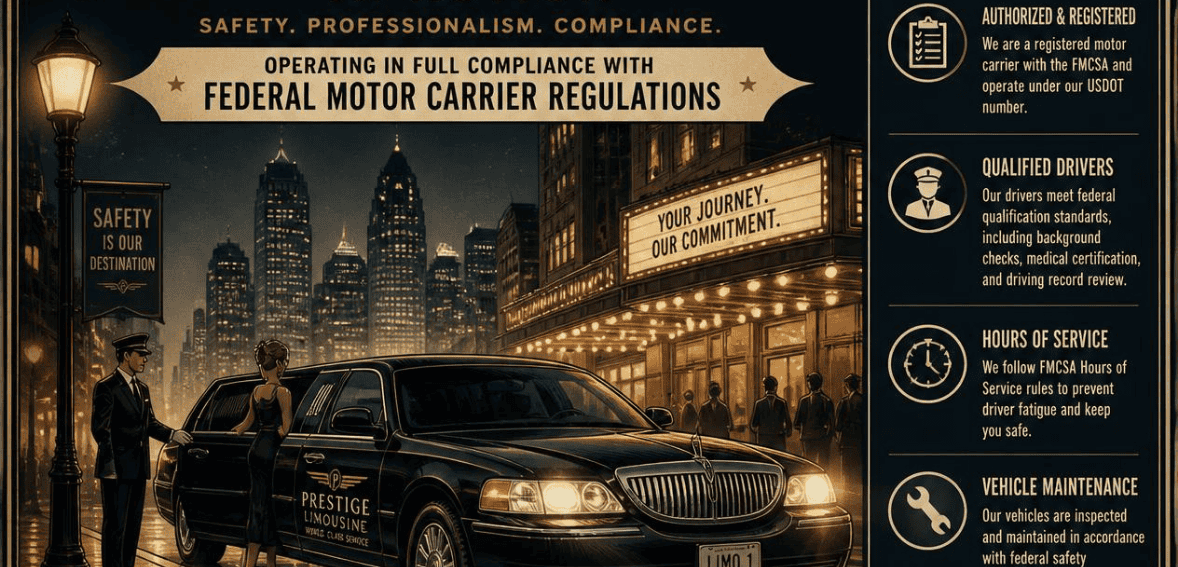
Many limo owners assume federal rules only touch big trucking fleets. Then a roadside inspection happens. Or an insurance audit. Suddenly, terms like “USDOT number” and “operating authority” show up in a compliance letter. The panic is real, and it is avoidable.
Here is the truth: FMCSA rules become applicable to limousine companies much sooner than operators expect. Just one airport transfer tied to an out-of-state flight can subject your company to federal oversight. Just one stretch limousine that seats 9 people can do the same. The rules are not concerned with the level of luxury in your fleet. They care about the number of passengers in your vehicle and whether your trips involve interstate commerce.
This guide explains everything you need to know about FMCSA Rules and regulations. By the end, you will have a good understanding of the scenarios in which the federal safety net covers your operation.
What Is the FMCSA and Why Should Limo Operators Care?
Federal Motor Carrier Safety Administration (FMCSA)
The Federal Motor Carrier Safety Administration is the federal agency that oversees commercial vehicles on U.S. roads. It writes and enforces the Federal Motor Carrier Safety Regulations, often shortened to FMCSRs. You will find these rules in Title 49 of the Code of Federal Regulations, Parts 390 through 399.
Passenger carriers and freight haulers are treated differently by the agency. For a limo company, this is a significant distinction. Freight regulations tend to focus more on the weight of the vehicle. Passenger regulations focus more on the capacity of the vehicle and the purpose of the trip. If you miss this distinction, you may greatly misjudge your compliance situation.
FMCSA draws a line between interstate and intrastate operations. If you cross that line, federal regulations apply to you, whether you have registered for them or not.
The Two Big Triggers: Vehicle Size and Interstate Commerce
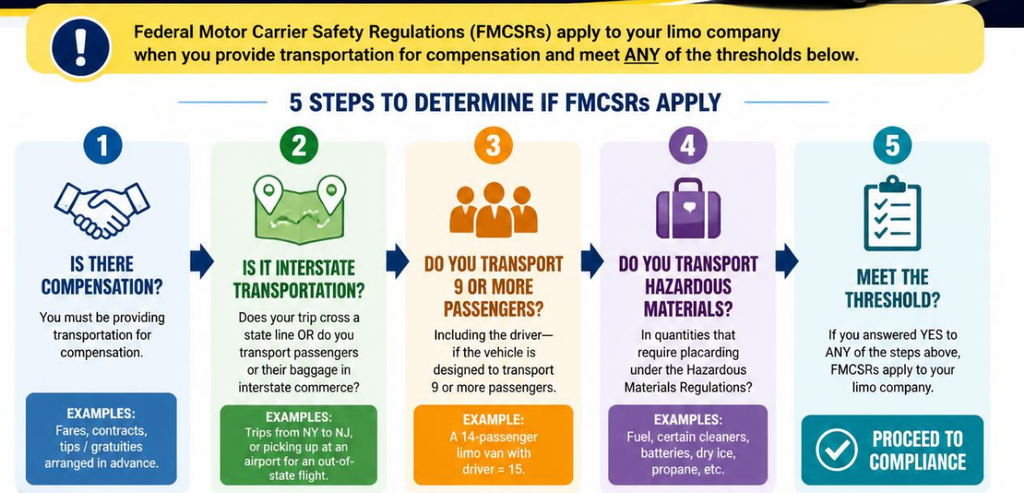
Federal oversight of a limo company almost always comes down to a pair of questions. First, how many people is your vehicle designed to carry? Second, are your passengers moving in interstate commerce? Answer both, and you can map your exact obligations.
How Seating Capacity Changes the Rules
Seating capacity is the first gate. The federal definition counts the driver in the total, so read your vehicle specs carefully.
If a vehicle meets the following three requirements, then generally, it is excluded from the federal safety regulations. First, the vehicle cannot carry more than 8 passengers. Second, the vehicle’s gross vehicle weight rating cannot exceed 10,000 pounds. Third, the vehicle cannot transport any placarded hazardous materials. This category typically includes a standard sedan or small six-passenger stretch limo. Just because a vehicle may be excluded from federal safety regulations does not mean that state and local limousine laws will not apply. It simply means the federal safety regulations will most likely not apply.
The federal safety regulations will apply to any vehicle that is designed to carry 9 to 15 passengers, including the driver, and that is used in interstate commerce. This is the category that many mid-size stretch limos and most executive vans belong to, and it is the category that typically surprises their operators.
The federal safety regulations will also apply to any vehicle that is designed to carry 16 or more passengers, including the driver. This category is considered to have the strictest obligations. Informally, most people will consider this category of vehicles to be commercial.
What Counts as Interstate Commerce for a Limo Company?
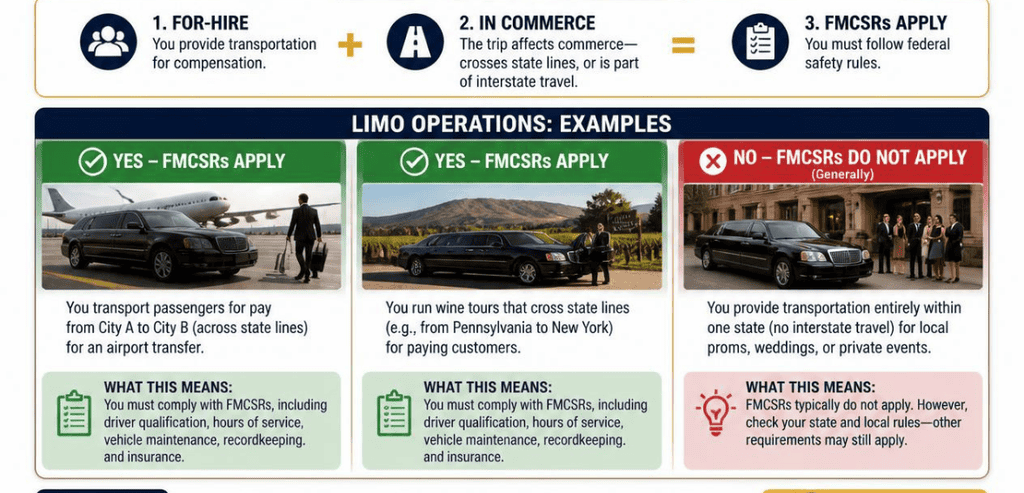
Interstate commerce is the second gate, and it is trickier than it sounds. The obvious case is a trip that physically crosses a state line. A limo running clients from New Jersey into Manhattan is interstate. Easy call.
Subtle cases never require travel beyond state borders to still be classified as interstate. In these cases, federal authorities focus on the passenger’s “fixed and persistent intent.” If a passenger books a limo as one segment of a trip that starts or ends in another state, that segment is part of continuous interstate commerce. Not crossing state lines with a vehicle will not provide much comfort to the courts.
Take the airport transfer example. If a traveler books a flight from Chicago to Orlando, and a limo from the airport to the resort, that limo ride is classified as interstate commerce. Switch it up a bit: if those passengers decide to hire a taxi once they land, with no prior booking, that ride is classified as intrastate travel. The deciding factor is the prearrangement.
This is why savvy operators track how each reservation was booked. A trip that looks purely local on a map can still be federally regulated based on the traveler’s intent.
FMCSA Rules for Limousine Companies by Vehicle Class
Now let us combine the two triggers. Your obligations depend on which seating tier your vehicle falls into and whether the trip is interstate.
Small Vehicles: 8 or Fewer Passengers
Limousines built to carry fewer than 9 passengers, under 10,001 pounds, and carrying no hazardous materials are generally exempt from the federal safety regulations. However, there are some things that trip people up. Being exempt from the safety regulations does not mean being exempt from everything. For-hire carriers that carry passengers across state lines are required to have operating authority and proof of insurance. This means that a small sedan service that operates interstate trips to the airport would have to maintain federal registration and, therefore, financial responsibility, even with its safety exemption.
Mid-Size Vehicles: 9 to 15 Passengers
This tier is the heart of FMCSA rules for limousine companies, and the form of payment decides how deep the rules go.
The main difference involves direct and indirect compensation. A passenger directly compensating your company for the ride means your company performs the ride as a stand-alone service, not part of a package. A limousine service operating 9- to 15-passenger vehicles with direct passenger compensation, regardless of trip length, is subject to the safety requirements of Part 385 and Parts 390 through 396. Such carriers must register with FMCSA, obtain a USDOT number, and place that number on their vehicles along with their legal or trade name.
Indirect compensation works differently. If a hotel includes a shuttle ride in the package price, the transportation charge is buried in the larger fee, so the carrier must register with the FMCSA but is exempt from most of the safety regulations. The payment structure literally changes your compliance burden.
Large Vehicles: 16 or More Passengers
Once your vehicle is designed to carry 16 or more people, including the driver, you are firmly in commercial motor vehicle territory. The driver must hold a valid commercial driver’s license with a passenger endorsement. The company must comply with the drug and alcohol testing rules in Part 382. And the financial responsibility floor jumps to $5 million. Party buses and larger shuttle coaches routinely land in this class, so operators expanding into bigger vehicles should plan for a serious step up in obligations.
For-Hire vs. Private: Are You a For-Hire Carrier?
Most limousine services are for-hire carriers, which has significant implications. The FMCSA classifies all carriers who transport paying passengers for hire as for-hire carriers. This includes transportation services that are either publicly or privately booked. The deciding factor is payment. Even a nonprofit organization that provides transportation services for a fee can be classified as a for-hire passenger carrier.
Being a for-hire passenger carrier has major implications. All for-hire passenger carriers that operate in interstate commerce must have FMCSA operating authority registration, regardless of fleet size. They must also carry the minimum required insurance: $1.5 million for vehicles with a seating capacity of 15 or fewer persons and $5 million for vehicles with a seating capacity of 16 or more. Finally, they must appoint a process agent, a person who can receive legal documents on behalf of the carrier.
The Airport 25-Mile Rule and Other Exceptions

The regulations offer some opportunities to provide transportation. One of these relates to transportation that is incidental to air travel. If all of the passengers in a ground vehicle are air travelers who have either just arrived or are about to leave, then as long as that transportation stays within a 25-mile radius of the airport, it is not subject to the FMCSA’s commercial regulations. Federal regulations may not reach short airport trips that remain close to the airport, even if the traveler’s journey includes interstate travel.
An exception for genuine taxi services exists as well. For a vehicle that does not seat more than 6 passengers and is not operated between fixed points or along a regular route, you could stay outside the financial responsibility regulations. These exceptions are narrow, however, and should be read literally. You should never just assume you qualify. Always check the precise language and interpretation.
What Compliance Actually Requires
When the federal regulations come into play, more tasks will come up on your list. Generally, you will need a USDOT number and, for interstate for-hire travel, operating authority. You also need to obtain and file the proper insurance. Depending on vehicle class, some of these requirements may include limits on hours-of-service, drug and alcohol testing, driver qualification files, vehicle inspection and maintenance records, and the use of electronic logs.
Federal regulations are not meant to be a burden on businesses. As vehicle size and trip types increase, so do the obligations — a small sedan operation carries fewer obligations than a party-bus operation. FMCSA has developed a simple guide to help small passenger-carrying vehicle operators (9- to 15-passenger vehicles) understand their obligations. It is the best place to start.
Conclusion
So when do federal motor carrier rules apply to a limo company? The honest answer is: more often than you might think. The moment your vehicle seats 9 or more passengers, or the moment a paid trip becomes part of an interstate journey, federal oversight is on the table. Add compensation, and for-hire status locks in registration and insurance duties even for the smallest cars.
The smart move is to audit your own operation now, before an inspector or auditor does it for you. Check your seating capacities. Review how your trips are booked. Confirm your compensation model. Then match those facts against the tiers above. Understanding the FMCSA rules for limousine companies is not just about avoiding fines. It is about running a safer, more credible, more scalable business. When you know exactly where you stand, compliance stops being a threat and becomes a competitive edge.
Frequently Asked Questions (FAQs)
Does a limo company need a USDOT number?
It depends on your vehicles and trips. A limo company operating 9- to 15-passenger vehicles for direct compensation in interstate commerce must obtain a USDOT number and mark it on each vehicle. Smaller for-hire cars crossing state lines may still owe registration and insurance filings even when most safety rules do not apply. Use the FMCSA’s registration tool to confirm your exact status.
Are federal rules triggered if my limo never leaves the state?
Sometimes, yes. If a passenger prearranges the ride as one leg of a trip that begins or ends in another state, that ride counts as interstate commerce. This holds even when your vehicle never crosses a state line. The passenger’s intent when the journey began is what matters.
Does my chauffeur need a commercial driver’s license?
Only for larger vehicles. A CDL with a passenger endorsement is required when the vehicle is designed to carry 16 or more people, including the driver. Standard sedans and mid-size stretch limos below that threshold generally do not require a CDL under federal rules, though your state may impose its own licensing requirements.
How much insurance does a for-hire limo company need?
For interstate for-hire passenger service, the federal minimum is $1.5 million for vehicles seating 15 or fewer passengers, including the driver. That figure rises to $5 million for vehicles seating 16 or more. State requirements may differ, so check both before you set your coverage.