
Picture a motorcoach rolling down the interstate at 2 a.m. The driver has been awake for 16 hours. The passengers are asleep, trusting that person behind the wheel with their lives. Now imagine that same driver is legally required to stop. That single requirement can be the difference between a safe arrival and a tragic headline. This is exactly why passenger carrier hours of service rules exist.
Fatigue poses a serious but silent threat to everyone on U.S. roadways. It impairs judgment and slows reaction times, jeopardizing everyone in the vehicle. In response, the federal government instituted strict driving regulations. If you operate a bus or a motorcoach, or run a shuttle service, these regulations impact how you run your business.
This passenger carrier hours of service guide explains the driving regulations that impact your business. We will discuss the essential driving limits, including the major exceptions as well as the distinctions between driving regulations for coaches and buses and those for trucking. Let’s get started.
Understanding Passenger Carrier Hours of Service Rules
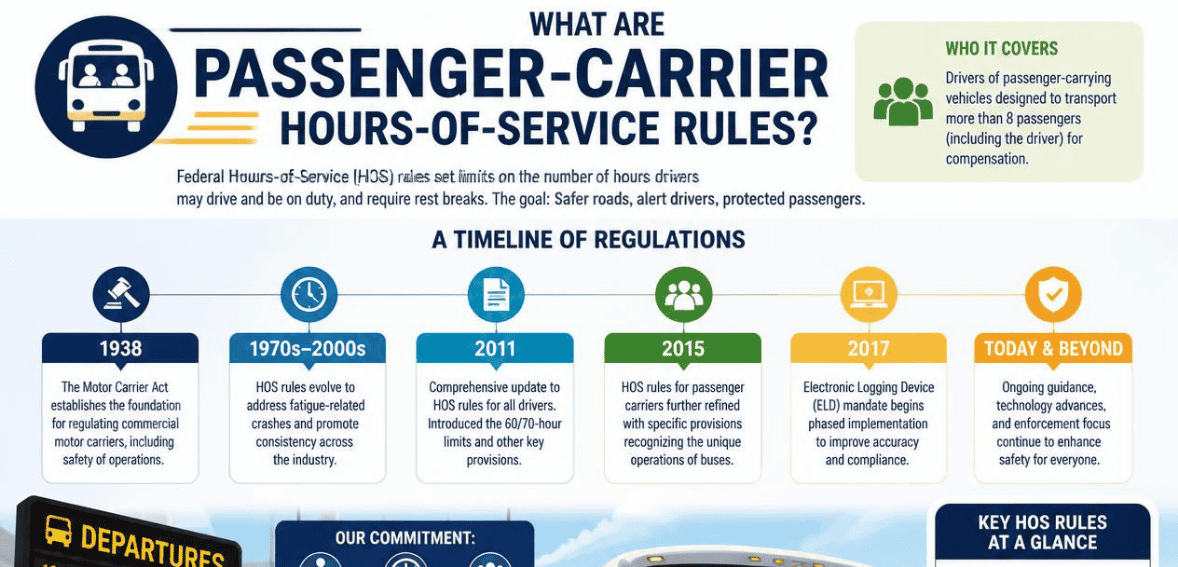
Hours-of-service rules are federal regulations that limit how long a commercial driver can work and drive. The goal is simple. Rested drivers are safer drivers. These rules live in the Federal Motor Carrier Safety Regulations, specifically under 49 CFR Part 395.
The Federal Motor Carrier Safety Administration drafts and enforces these regulations. There are primarily two types of rules. One is for drivers transporting property, such as truck drivers transporting goods. The other is for drivers transporting passengers, such as bus and motor coach drivers. While both rules look alike, there are significant differences.
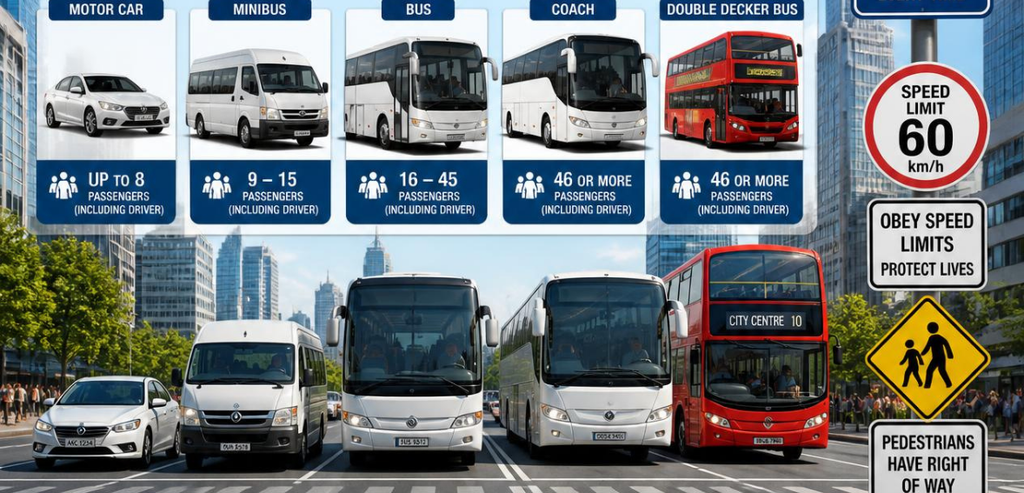
Rules concerning passenger-carrier hours-of-service apply to drivers of commercial motor vehicles designed and constructed for the purpose of carrying people. This includes over-the-road buses, motor coaches, as well as passenger vans, designed for compensation. The regulations apply when the vehicle is used in interstate commerce and meets certain requirements concerning size and/or passenger capacity.
Federal Motor Carrier Safety Administration (FMCSA)
The FMCSA is the safety regulator for the commercial motor vehicle industry within the USDOT. They have driving limits and provides guidance. They also partner with states for roadside compliance. When a rule is published, it comes from the FMCSA.
The FMCSA also runs the Compliance, Safety, Accountability program. This program is responsible for tracking and scoring violations. More on that later.
The Core Passenger Carrier Driving Limits
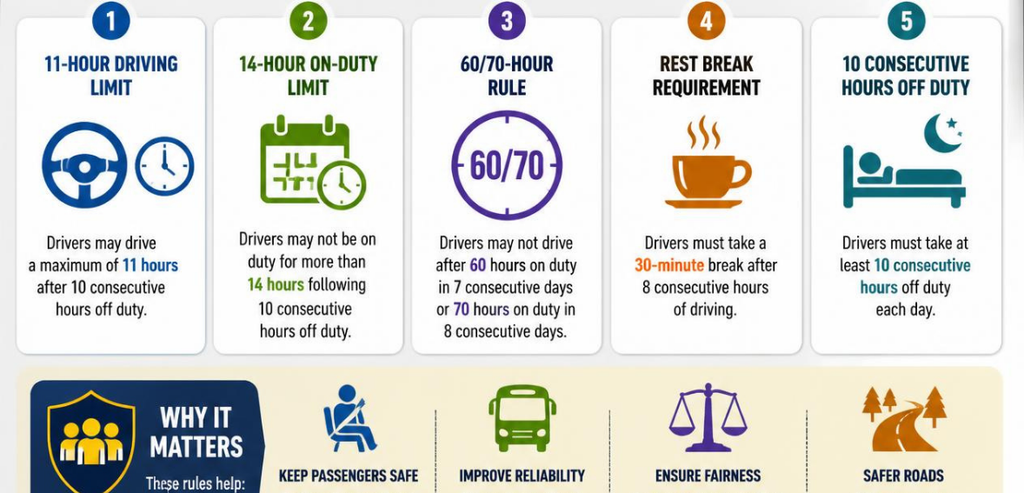
Let’s start with the numbers that matter most. Passenger-carrying drivers follow a 10-hour driving limit and a 15-hour on-duty limit. These two limits work together and form the backbone of daily compliance.
The 10-Hour Driving Limit
A passenger-carrying driver may drive a maximum of 10 hours. This is only allowed after taking 8 consecutive hours off duty. Once the driver hits that 10-hour mark, driving must stop. No exceptions unless a specific provision applies.
Think of it this way. Eight hours of rest earns a driver up to ten hours behind the wheel. It is a clean trade that protects both the driver and the people on board.
The 15-Hour On-Duty Limit
No driver can operate a vehicle after being on-duty for a total of 15 hours, and the counting of this 15-hour record begins after 8 consecutive hours off duty have been taken. Here is the part that most people get wrong. Off-duty time does not count toward the 15 hours.
This aspect differentiates the regulations from the trucking industry substantially. For a truck driver, the 14-hour period is constant, while for a bus driver, the 15-hour period can stretch over a much longer time frame. This is because the breaks and meal stops count as off-duty time. The flexibility this rule provides can help the bus companies manage the tours, layovers and split runs.
Weekly Limits and the Missing Restart
Daily limits are only half the picture. Weekly limits stop drivers from working long stretches without real rest.
A passenger-carrying vehicle operator must observe the following limits: They may not drive for more than 60 hours on-duty in any 7 days. If the company operates vehicles 7-days a week, this limit extends to 70 hours in 8 days. These limits are placed to address the issue of fatigue from the accumulation of hours where the daily limits do not address the issue.
In order to understand why this may present a challenge to new operators, passenger vehicle carriers have no provision for the 34-hour restart. Truck drivers are able to reset a weekly limit by taking a 34-hour break. This is not the case for bus and motorcoach drivers. Once the weekly limit is reached, the driver must wait for the hours to roll off the calendar. This makes scheduling a top priority for operators of passenger vehicles.
Sleeper Berth and Adverse Driving Provisions
Long routes sometimes call for rest along the way. The rules build in a few practical allowances for that reality.
The Sleeper Berth Provision
Many motorcoaches carry a sleeper berth. Drivers using one must take at least 8 hours in the berth. They may split that time into two separate periods. Neither period can be shorter than 2 hours. All berth time paired together must add up to at least 8 hours.
This split-sleeper option gives drivers a way to rest without burning a full block of time all at once. It suits overnight tours and relay-style operations well.
The Adverse Driving Conditions Exception
Weather and traffic are not completely predictable. Adverse weather conditions create leeway for drivers. Both the 10-hour driving limit and the 15-hour on-duty limit are extended by two hours in the case of adverse driving conditions.
Conditions which are considered adverse include snow and ice, as well as unusual road and traffic conditions. The operative term is “unusual.” The driver would not have been able to anticipate the condition before beginning the trip. This exception is not intended for the driver to use as a way to get in extra miles.
The Short-Haul Exception for Passenger Carriers

Not every bus driver travels long distances. Shuttle services and local transit often stay close to home. The short-haul exception recognizes this.
A driver does not have to log hours if two standards are met. One, the driver must stay inside a 150 air-mile radius from their normal work reporting location. Two, the driver’s work shift does not exceed 14-hours. The driver must also report to and return from the same location in the 14-hour window.
When the driver meets the standards, the company completes simplified time records in lieu of a full log. If the driver exceeds either the mileage or the hours in a day, then the short-haul exception does not apply and a regular log or electronic logging device is required for that day.
Electronic Logging Devices and Record Keeping
Paper logs are largely a thing of the past. Most passenger carriers now track hours with electronic logging devices, commonly called ELDs. These devices connect to the engine and record driving time automatically. They make cheating far harder and roadside inspections faster.
Carriers can only use ELDs that are self-certified and can be found on the FMCSA’s registered device list. Using ELDs not on the list can result in consequences during an audit. Fleet managers must ensure that the device is registered prior to system procurement.
One exception to consider is that the record-keeping requirements do not apply to non-business private motor carriers of passengers. Therefore, they are not required to keep a logbook or a record of their duty status.
For carriers using part-time or multiple-employer drivers, there is an additional requirement. The carrier must obtain a signed statement that includes the driver’s total on-duty time in the previous 7-days as well as the time when the driver was last relieved from duty. This requirement is in place to ensure that a driver does not work for multiple employers to accumulate an excessive amount of duty time.
Why Compliance Matters: Penalties and Safety Scores
These rules are not suggestions. Enforcement is real, and the consequences bite.
Violations are logged during roadside inspections. Serious safety violations will result in an order to cease operations. This means the driver has to stop, the trip has to stop, and the passengers are left to wait until someone is sent to relieve the driver. For a traveling tour business, this is not only a loss of money, it is also highly unprofessional.
In addition to the order to cease operations, violations will negatively impact a carrier’s safety rating. Poor ratings in the hours of service category of the Compliance, Safety, Accountability program will result in an increase in the frequency of regulatory audits. The civil monetary penalties for the hours of service violations also increase and can quickly become financially unmanageable.
The primary reason to maintain compliance is not to avoid the monetary penalties. Keeping compliance with the hours of service regulations means that the risk of drowsy driving is minimized. This means protecting passengers. The value of decreased risk is substantial. The FMCSA has a comprehensive summary of the safety and hours of service regulatory framework, and the official hours of service regulations can be found in 49 CFR 395.
Passenger vs. Property Carriers: The Key Differences
It’s beneficial to illustrate the differences. After their 10 hours off duty, property carriers are allowed to drive for a maximum of 11 hours. After their 8 hours off duty, passenger carriers are allowed to drive for a maximum of 10 hours. Property drivers are required to work within a 14-hour blocked time that is continuous. Passenger drivers are required to work within a 15-hour blocked time that can be a stretch of off-duty time.
Property carriers are required to take a break of 30 minutes after driving for a maximum of 8 hours. That break is not required for passenger carriers. In addition, only property carriers are allowed to take the 34-hour rest break. It is important to recognize the difference in the regulations for the carriers because it is frequent and costly for the carriers to misapply the regulations.
Conclusion
Passenger-carrier hours-of-service rules exist for one simple reason. Human lives are on the line every time a bus pulls out of the depot. The framework is clear once you learn it. Ten hours of driving. A fifteen-hour on-duty limit. A sixty or seventy-hour weekly cap with no restart. Add the sleeper berth, adverse driving, and short-haul provisions, and you have the full toolkit.
For drivers, these limits are guardrails that keep you sharp. For fleet managers, they are the foundation of a clean safety record. Learn them well, build smart schedules around them, and lean on registered ELDs to stay accurate. Compliance is not just about avoiding fines. It is about making sure every passenger gets home safe. That is a standard worth driving toward.
Frequently Asked Questions
How many hours can a passenger carrier driver drive in one day?
A passenger-carrying driver may drive a maximum of 10 hours. This is allowed only after taking 8 consecutive hours off duty. The driver also cannot drive after being on-duty for 15 hours total, though off-duty time does not count toward that 15-hour limit.
Do passenger carriers get a 34-hour restart like truck drivers?
No. This is one of the biggest differences between the two rulebooks. Property-carrying truck drivers can reset their weekly hours with 34 consecutive hours off duty. Passenger-carrying drivers cannot use a restart and must wait for older hours to age off their weekly total.
Are bus drivers required to take a 30-minute break?
No. The mandatory 30-minute driving break applies only to property-carrying drivers. Passenger carriers are not subject to that specific requirement, though drivers are always free to rest as needed and often should.
Who enforces passenger carrier hours of service rules?
The Federal Motor Carrier Safety Administration writes and enforces these regulations. Enforcement happens through roadside inspections, compliance audits, and the Compliance, Safety, Accountability scoring system. Serious violations can lead to out-of-service orders and significant civil penalties.