
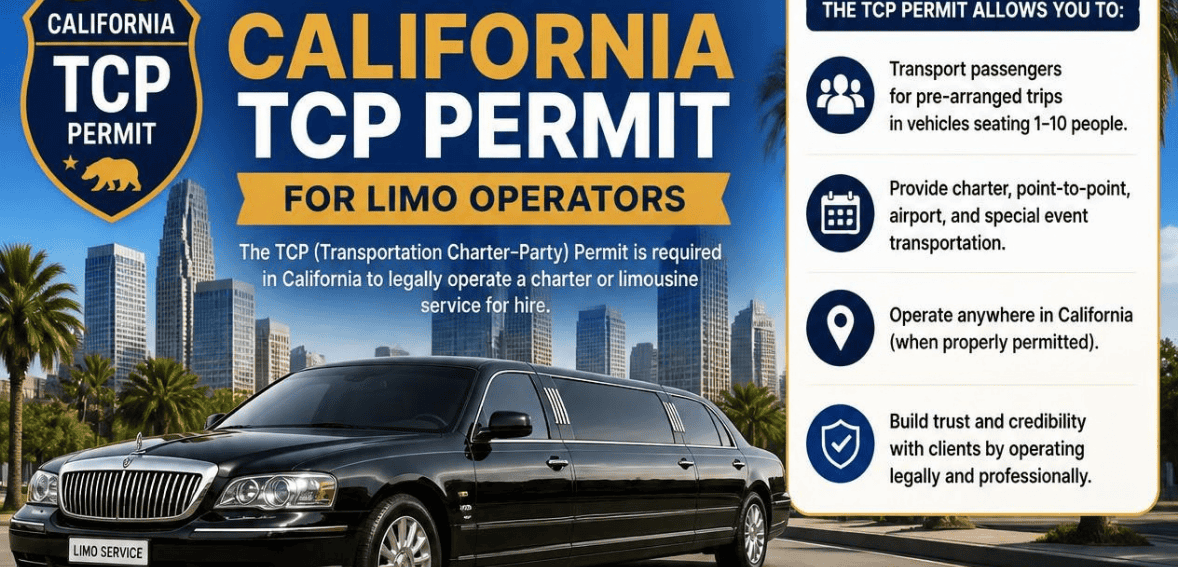
“You have your TCP number yet?” your buddy asks. No one told you that a black Lincoln and some clients weren’t all you needed. Turns out you can drive around looking nice but be fined and have your car taken away for essentially being a taxi.
With all the fancy bells and whistles you’d expect from a high-end car, the California TCP permit for private passenger transport is appropriate if you’re considering a town car, shuttle, or limo. This article tells you all you need to know about the California TCP permit, including the issuing body, costs, and the approval process done on your behalf.
What Is a California TCP Permit, Exactly?
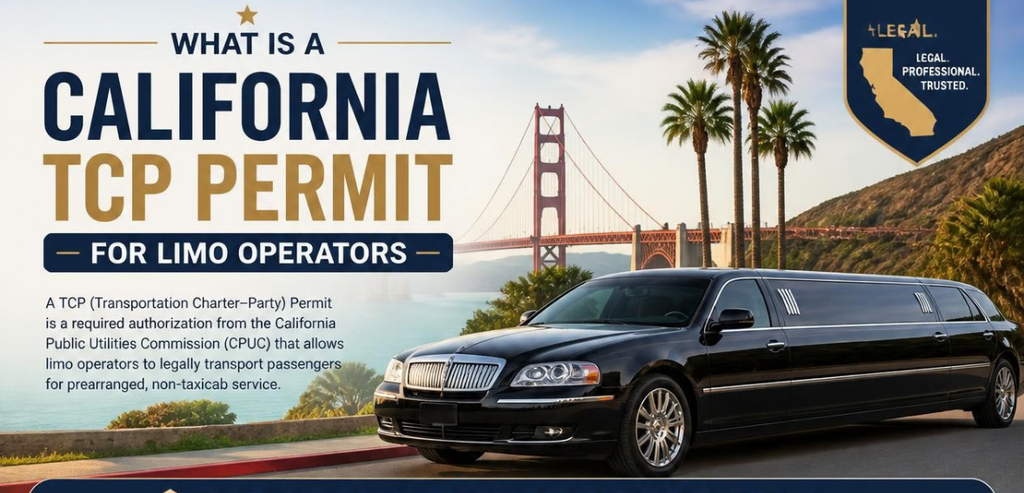
TCP stands for Transportation Charter-Party Carrier. A California TCP permit is the state license that lets you legally transport passengers for compensation on a prearranged, charter basis. Think of weddings, airport runs, corporate accounts, and night-out packages. The passenger books your vehicle for exclusive use, and you charge for the trip.
The important word is “charter.” A charter-party carrier does exactly that. You are not a taxi cab that picks up people off the street. A client books an entire limo for their event and only they and their guests ride in it.
A California TCP permit requires that a limousine business cannot operate on just a handshake. The permit functions a lot like insurance and registration for normal drivers. If you do not have it, your professional-looking business is not legal to operate on the street and any trips for hire that you run are unlawful.
The California Public Utilities Commission (CPUC)
The California TCP permit is issued and regulated by the California Public Utilities Commission (CPUC). This state agency oversees charter-party carriers, including limousines, black cars, party buses, and airport shuttles. It sets the rules for insurance, driver safety, and vehicle standards across California.
The CPUC has an online module called TCPortal, where you can submit applications, add drivers, and submit other filing updates. You can check the official program details on the CPUC Charter-Party Carriers page. All records of your applications, renewals, and everything in between are processed through this agency. You may want to get used to this system early, as you will likely have to deal with the CPUC for the life of your business.
Who Needs a California TCP Permit for a Limousine?
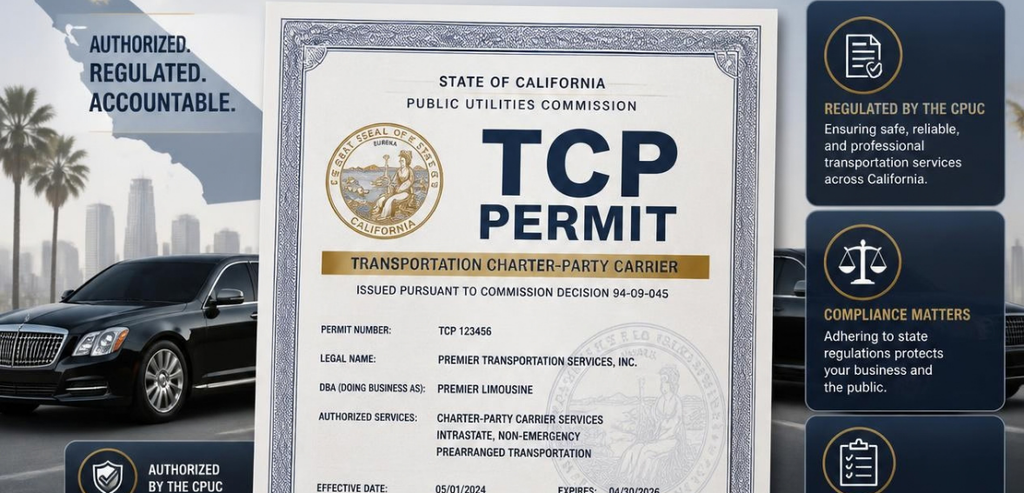
Most businesses that provide ground transportation services in California will need Transportation Charter-Party (TCP) authority. If you provide transportation in a limousine, sedan, SUV, van, or bus for hire on a scheduled or contract basis, you will need a TCP. This includes transportation for hire when provided in limousines for weddings, proms, and other special events, as well as airport shuttles, wine tours, and corporate transportation services.
There are a couple of exceptions. Taxicabs are regulated at the city and county level and are not regulated by the California Public Utilities Commission (CPUC), as are certain medical transport services. However, when it comes to standard and luxury limousine services, the California TCP permit is the primary requirement.
Rideshare is a different situation. Companies like Uber and Lyft fall under a different TCP category for transportation network companies. Even in the app-based transportation world, a variation of the same permit is in effect.
The Types of TCP Authority Explained
Not every California TCP permit is the same. The CPUC offers several classes of authority, and the one you pick shapes your fees, your insurance limits, and your inspection rules. You must choose the right class for the service you plan to offer, because each certificate covers a different type of operation.
Certificates: Class A, B, and C
The Class A certificate is the most extensive of the three. It provides the ability to service charter trips statewide and round-trip sightseeing, with the ability to charge individual fares in some instances. The Class A certificate filing fee is $1,500.
The Class B certificate covers charter trips with pickup areas within 125 air miles of the home terminal, which would cover most of the state. However, if you are operating a larger vehicle, the distance requirement does not apply. The Class C certificate is the most restrictive of the three and applies to transportation that is incidental to some other primary service like commercial ballooning, river rafting, or skiing. The Class B and Class C certificates have a filing fee of $1,000.
Permits: P, S, and Z
Most limousine startups apply for the “P” permit. This charter-party permit is designed for carriers using smaller vehicles, and it is the common starting point for a single limo or a small fleet. The filing fee is $1,000.
Tours that the operator directs, like a city tour, fall under the “S” permit. Those needing the “Z” permit are specialized carriers that work under contract and do not serve the general public. This includes businesses, schools, and governmental contracts. One of the most common reasons that applications are rejected is due to having the wrong permit. Make sure to select the correct class for the way you intend to profit.
This is a brief overview of how vehicles are defined. A limousine, per the CPUC, is a vehicle that can carry 10 or fewer passengers. A modified limousine is any vehicle that has been stretched, altered, or extended like a stretch limousine. Modified limousines are subject to additional inspections, which we will discuss next.
TCP Insurance Requirements for Limo Operators
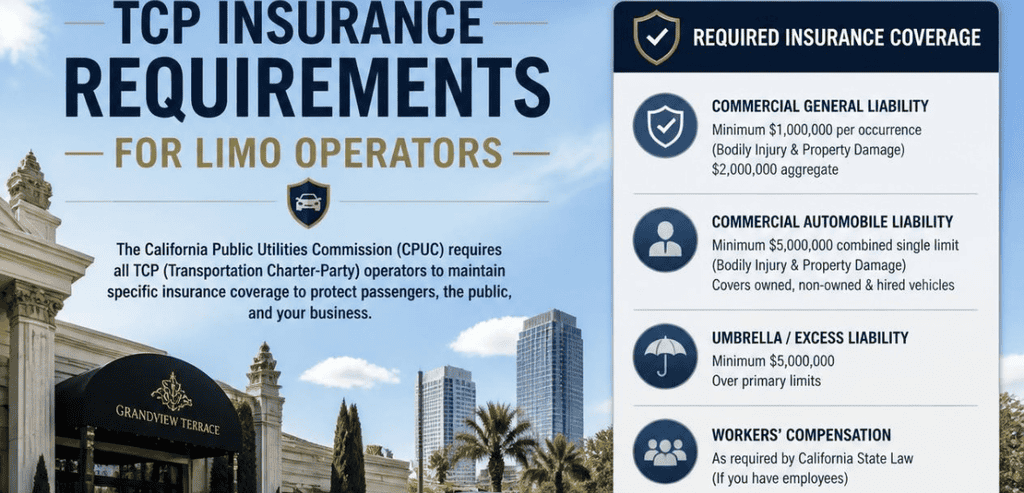
Insurance is where many new operators get stuck. The CPUC will not activate your California TCP permit until proof of liability insurance is on file. And the required amount scales with how many passengers your vehicle can hold.
For vehicles that carry up to seven passengers (including the driver), the minimum required liability coverage is $750,000. For vehicles that carry from eight to fifteen passengers, the required minimum is $1,500,000. For vehicles that carry sixteen or more passengers, the required minimum is $5,000,000. These limits are based on the CPUC’s General Order 115-G and are not negotiable.
Your insurance broker files the coverage with the CPUC. Coverage is generally required to have a 30-day notice-of-cancellation endorsement, or it will be considered non-compliant. If you employ the drivers, you are also required to have workers’ compensation insurance. The cost of insurance for a limo will most likely be the highest of all the ongoing costs, so confirm the limits and then purchase the vehicle, but be sure to shop your policy.
How to Apply for a California TCP Permit
The application process runs through the CPUC’s online TCPortal, and it rewards preparation. Rushing in without your documents ready is the fastest way to a rejection or a long delay.
First, gather your business information. You’ll need your legal entity info, address, ownership records, and the list of vehicles you intend to operate. Each vehicle must possess a commercial DMV registration. If the vehicle is financed, you may be subject to a delay of a month or longer for the registration to be processed.
The core application is Form PL739, and vehicles are listed on Form PL664. If the vehicle is a modified limousine or has a seating capacity of greater than 10, you will need to obtain a CA number and a CHP inspection. Your drivers also must be part of a substance and alcohol testing program, and your business must be part of the DMV Employer Pull-Notice system, which keeps track of employee driving records. You can review the application in its entirety in the TCPortal application guide.
Here’s a critical point about drivers. Only company owners and company W-2 employees are allowed to drive under your TCP permit. Gig-style driving is also not permissible under your authority unless of course, the driver possesses their own TCP license.
The CPUC requires you to meet all of the enrollment requirements, including insurance and testing, within 90 days of the application submission. Filing fees are not refundable; therefore, only begin the process when you are ready to operate.
Renewing and Keeping Your TCP Permit Active
Getting approved is not a one-time event. A California TCP permit must be renewed every three years, and the renewal fee is $100. Miss the renewal, and your authority can lapse, which forces you back to square one.
Remaining active means that you keep all of your insurance up to date. One lapse of insurance coverage can result in your permit being suspended or revoked. You must also maintain your annual CHP inspections for your vehicles when required, keep your drug and alcohol testing program and records, and maintain your driver records. You can find your ongoing requirements on the CPUC Passenger Carrier FAQs for further information.
Most operators view compliance as a one-time hurdle that must be completed; however, the successful operators have integrated compliance as part of their daily business. The operators that have a successful and lasting business are the operators that never have an inspection or policy lapse.
Common Mistakes Limo Operators Make
The most common mistake is operating before approval. The owner’s excitement leads to taking a booking and driving with an application still pending. Both are illegal and unsafe.
Another mistake is selecting an incorrect permit class. An example would be selecting a “P” permit for a large 14-passenger van, leading to rejection of the application and a loss of money due to the responsibility to repay the fees. Owners also miscalculate insurance costs and forget to register the commercial vehicle, and believe gig drivers are permitted to drive under their permit. All of these mistakes are time-wasting, money-draining mistakes that could have been prevented by a little research.
Conclusion
A California TCP permit is the foundation of any legitimate limousine business in the state. It proves you are properly insured, that your drivers are screened, and that your vehicles meet safety standards. Without it, you are not really in business. With it, you can bid on corporate accounts, work with airports, and build a brand clients trust.
The path is clear even if it takes patience. Choose the right class of authority, line up insurance that meets the CPUC minimums, register your vehicles commercially, and file a clean application through TCPortal. Then protect that permit by renewing on time and keeping every document current. Do that, and your California TCP permit limousine operation can run legally and grow with confidence.
Frequently Asked Questions
How long does it take to get a California TCP permit?
Timelines vary based on your paperwork and insurance. A well-prepared application can clear in a few weeks, but missing documents or a mismatched permit class can stretch it to several months. The CPUC expects all requirements to be met within 90 days of starting.
How much does a TCP permit cost in California?
The filing fee depends on the class of authority. A Class A certificate costs $1,500, while Class B, Class C, and the P, S, and Z permits each cost $1,000. Renewal every three years costs $100. Insurance is a separate and larger ongoing expense.
Do I need insurance before my TCP permit is approved?
Yes. The CPUC will not activate your authority until proof of liability insurance is on file. Coverage ranges from $750,000 for smaller vehicles to $5,000,000 for vehicles seating 16 or more passengers, based on seating capacity.
Can I hire 1099 contract drivers under my TCP permit?
No. Drivers must be the business owner or W-2 employees to operate under your permit. A 1099 contractor can only drive if they hold their own TCP license. This is one of the most common compliance mistakes new operators make.