

By John James June 18, 2026
Why Luggage Conversation Belongs at Booking, Not at the Curb
Usually, conversations about booking a limo focus on the pickup time and place, the number of passengers, and any preferences regarding the limo type. Luggage is usually an afterthought. This is a big mistake for several reasons.
The capacity for luggage in a limo is a comfort issue but also a matter of logistics and liability, and in some cases, safety. For example, overstuffing a trunk can damage the luggage, obstruct the rear view, and cause issues with the doors. It can even result in leaving a client waiting at the airport when their luggage won’t fit in the limo.
The luggage conversation about volume belongs at the same moment you confirm passenger count. It’s booking-accuracy work, not an afterthought. Think of it the same way you’d think about confirming the number of child seats or whether the client needs a meet-and-greet service. It’s operational data. You need it to do your job correctly.
How to Ask About Luggage Volume Without Making Clients Feel Interrogated
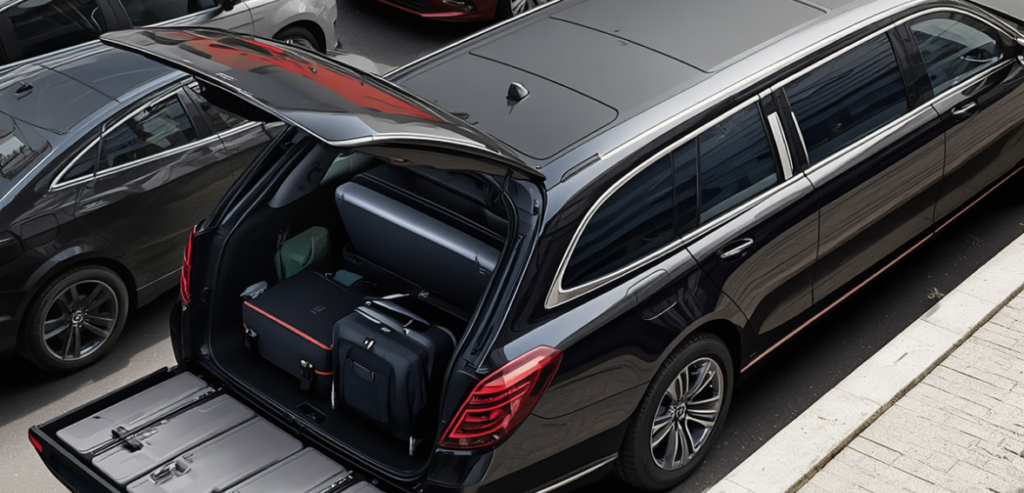
“Interrogated” may be somewhat overstating the case, but not by much. Asking lots of questions about suitcase dimensions and bag counts can definitely make a client feel like they’re being vetted. Answering questions about luggage should feel like one more step in customizing a client’s experience, not like being put under the microscope.
One of the best ways to ask about luggage is to include the question in a vehicle recommendation. Ask, “How many bags do you have?” in a way that provides a rationale for the question related to the vehicle recommendation. For example, “To make sure we get you the right vehicle, can you give me a rough idea of how much luggage you’re traveling with?” is a much more client-centered way of asking the question.
Another great way to ask about luggage is to provide the client with an example. For instance, letting a client know that the booked sedan “comfortably fits two standard checked bags and two carry-ons” provides the client with a standard the client can relate to, making it much more likely they will provide a correct answer and much less likely the client will be surprised at the booked vehicle at curbside.
For corporate accounts and repeat clients, build luggage preferences into their profile. If a client always travels with a golf bag and two suitcases, that note in their file is worth more than any awkward conversation at checkout. It makes the service feel personalized, not interrogative.
Written confirmation also carries weight. Including a brief luggage note in the booking confirmation email — “Your executive sedan accommodates up to two standard checked bags” — lets clients self-identify mismatches before the day of the ride. No phone call needed.
Limo Luggage Capacity by Vehicle Class: What Fits vs. What Needs a Cargo Upgrade

Knowing limo luggage capacity by type is where operational skill truly adds value. Every class of vehicle has a sensible limit, and exceeding it will create challenges that good spirit and a positive attitude can’t fix on the day.
Executive Sedans
Executive sedans like the Cadillac CT6, Lincoln Continental, and Genesis G90 are the go-to for airport transfers. Their trunks are meant for business, not leisure. A sedan trunk can carry about two standard-sized checked bags, and one or more carry-ons. Add a briefcase, and you’re done.
For clients traveling with oversized, multiple, or more than three bags, including ski bags, a sedan will definitely not work for them. This is the most common class for luggage mismatches, simply because sedans are booked so often.
Luxury SUVs
The tier of vehicles comprised of Cadillacs, Chevrolets, Lincolns, and Mercedes are the upper echelon SUVs. Each of these models can be customized to fit your cargo space. Even with seating for a full party, the space behind the third row can carry between three and four suitcases. Without all the seating in place, that cargo space increases dramatically.
SUVs of this caliber are perfect for families or transporting clients with sporting equipment. They are also ideal for transporting groups with luggage that exceeds the capacity of a standard sedan. They excel in carrying golf clubs, instrument cases, and baby strollers—items that often create booking challenges for sedans.
Stretch Limousines
Many clients—and some operators—are surprised to learn that stretch limousines have many limitations regarding luggage. Stretch limousines have an extended chassis that increases the passenger cabin. Because of this, each trunk has much less room than in a regular car. In general, stretch limousines have the capacity of about two to three standard checked bags. This count could even be lower, depending on the car’s make and the bar equipment in the trunk.
Getting to the airport with a big group means bringing a lot of luggage. Clients who bring one piece of luggage per person for the trip almost always present a problem when booking a stretch limo. Clients should be aware that a stretch limo is designed for celebrations, not for luggage. During the booking process, operators should advise clients of this issue and recommend that a companion SUV or other cargo-carrying vehicle is required when traveling with a group and luggage.
Sprinter Vans and Executive Vans
Executive vans, such as those featuring Mercedes-Benz Sprinter van technology, provide highly flexible solutions for the cargo needs of most limo services. Depending on the layout, seating for 8 to 14 passengers and cargo capacity vary significantly, but the rear cargo area can accommodate 6-10 or more bags. Some Sprinter models offer dedicated storage with overhead and underfloor spaces.
The Sprinter van is the best option for group airport transfers, corporate shuttle services, and, in fact, any service where both the number of passengers and the number of bags is significantly large. It makes the booking discussions much easier, as this is the service operators are quite confident in offering.
Mini Coaches and Charter Buses
For larger groups, the luggage conversation shifts from trunk space to undercarriage bays. Mini coaches and full-size charter buses store luggage in dedicated compartments below the passenger floor. This is generally the most luggage-friendly configuration available. Groups of 20 or more passengers with full luggage loads are typically well served by this vehicle class without any cargo upgrades.
What to Do When a Client Arrives with More Luggage Than the Booked Vehicle Can Handle

No matter how careful an operator is, mismatches inevitably happen. Problems include a client underestimating the size of their luggage, last-minute gifts added to the bag, and extra bags brought by travel companions. As a result, the vehicle arrives, and the operator is simply left with the problem.
One of the critical defining activities of an operator is how they deal with mismatches. The worst option is to be outwardly frustrated, blame the client, and refuse to offer a solution. The best option is to have a response protocol that the driver executes calmly and professionally.
To respond to such mismatches, every fleet should have a dispatch-on-call system. In the case of a luggage mismatch at a pickup, the driver notifies dispatch. If a vehicle of the correct size is available and can reach the location in a reasonable time, dispatch will send a second vehicle (a “bag car”) to transport the luggage while the client continues their journey. The protocol is designed to maintain a seamless travel experience.
If a second vehicle isn’t available, the driver should attempt to fit what’s safely possible and communicate transparently with the client about what can and cannot travel in the current vehicle. Never strap luggage to exterior surfaces. Never compromise trunk closure or visibility. If some bags genuinely cannot travel, that becomes a conversation about rebooking or secure storage — not a roadside argument.
Those operators who manage it well—quickly, without any visible stress, while presenting a solution—probably earn more customer loyalty at that challenging moment than from any number of perfect trips. Customers do not forget how a solution was provided.
However, prevention should take priority over handling the issue in the first place. Most of these problems can be avoided with some form of automation that reminds the customer, booking confirmation emails that state the luggage allowance, and booking agents who can ask the appropriate questions at the time of booking.
Conclusion
Limo luggage capacity is one of those operational details that feel minor until they aren’t. Getting it wrong costs time, creates stress, and can turn a premium service experience into an embarrassing scramble at the worst possible moment. Getting it right — by asking the right questions at booking, matching vehicle class to actual cargo needs, and having a recovery plan for the exceptions — is what separates professional operators from those who are simply moving vehicles around.
The awkwardness people associate with luggage conversations disappears the moment you frame them as a service. You’re not interrogating your client. You’re making sure their ride is right. That’s the job.
Frequently Asked Questions
How do I know if my luggage will fit in the limo I booked?
Ask your booking agent directly during the reservation process. Reputable limo services will give you a clear breakdown of their vehicle’s cargo capacity — typically stated in number of standard checked bags and carry-ons. If you’re unsure about your bag count or dimensions, describe what you’re traveling with and let the agent recommend the right vehicle class.
Do stretch limousines have more trunk space than regular sedans?
Not necessarily. Stretch limousines are extended to expand the passenger cabin, not the cargo area. In many cases, a stretch limo trunk holds the same or fewer bags than a luxury sedan. If your group is traveling with significant luggage, a Sprinter van or luxury SUV is usually a better fit than a stretch.
What happens if my bags don’t fit in the booked vehicle on pickup day?
A professional limo operator will contact dispatch immediately and work toward a solution — whether that’s a second vehicle for the luggage, a same-day vehicle upgrade, or a safe alternative arrangement. You should never be left stranded. To avoid this situation entirely, communicate your luggage details at the time of booking.
Is it rude to ask my limo service about luggage space?
Not at all. Experienced operators expect and appreciate these questions. Knowing your luggage details helps them assign the right vehicle, which means a smoother experience for everyone. Think of it the same way you’d ask about legroom or vehicle amenities — it’s a standard part of the booking conversation.