
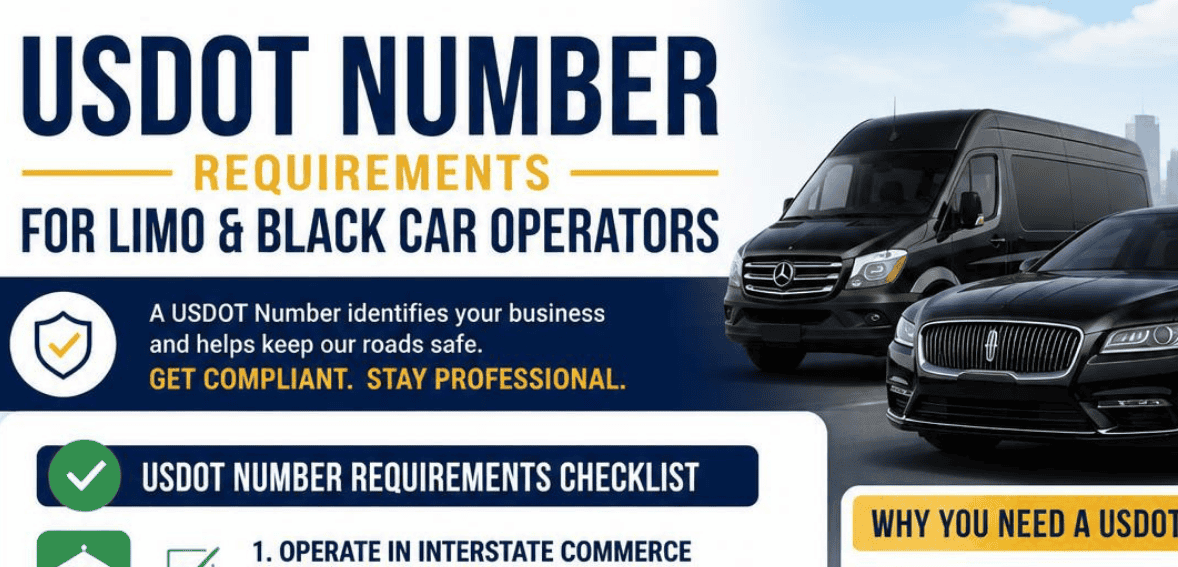
Picture this. You just launched a black car service. The bookings are rolling in. Then a client asks for an airport run that crosses a state line. Suddenly you wonder if you are missing a federal license. That single question stops a lot of new operators cold.
A limo company might need a DOT number. There are a few variables. Primarily, it depends on how many passengers are carried, whether you go across state lines, and your state’s regulations. This guide will answer your questions and simplify the regulations. By the end you will know if and where your operation is affected.
What a USDOT Number Actually Is
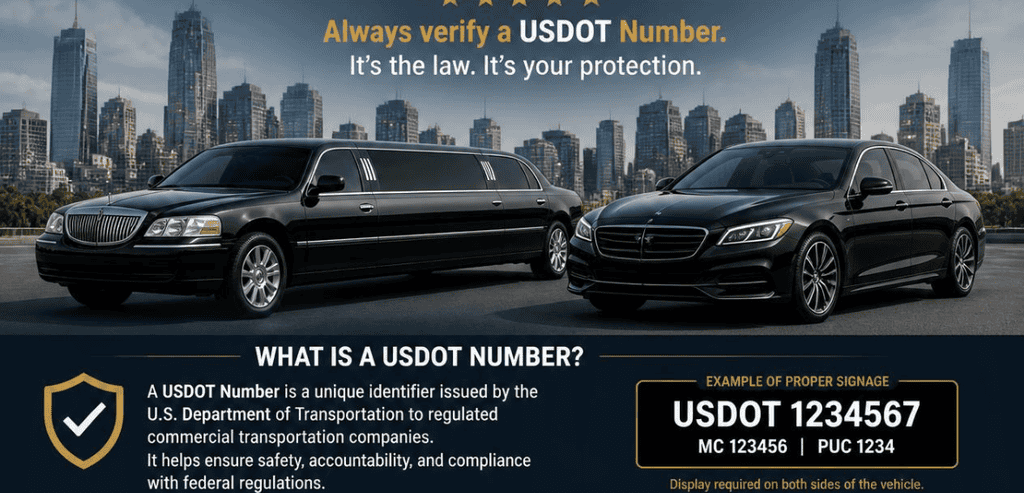
A USDOT number is a unique identifier assigned by federal regulators. It follows your company, not your vehicle. Think of it as a safety fingerprint. It links your business to inspections, audits, crash reports, and compliance reviews. Officials use it to track your safety record over time.
The number itself is free. There is no application fee to get one. But the rules around who needs one are strict. Ignore them and the penalties get expensive fast.
Federal Motor Carrier Safety Administration (FMCSA)
The agency that provides USDOT numbers is the FMCSA, an agency within the U.S. DOT. They aim to minimize accidents involving commercial vehicles. The safety guidelines for passenger vehicle transportation (including limousines and black cars) are created by the FMCSA. These might include rules for the qualifications of drivers, vehicle maintenance, the hours of duty, and the testing for drugs and alcohol. If your business practices fall into the category that requires you to register, then you are governed by these federal regulations.
Does a Limo Company Need a DOT Number? the Short Answer
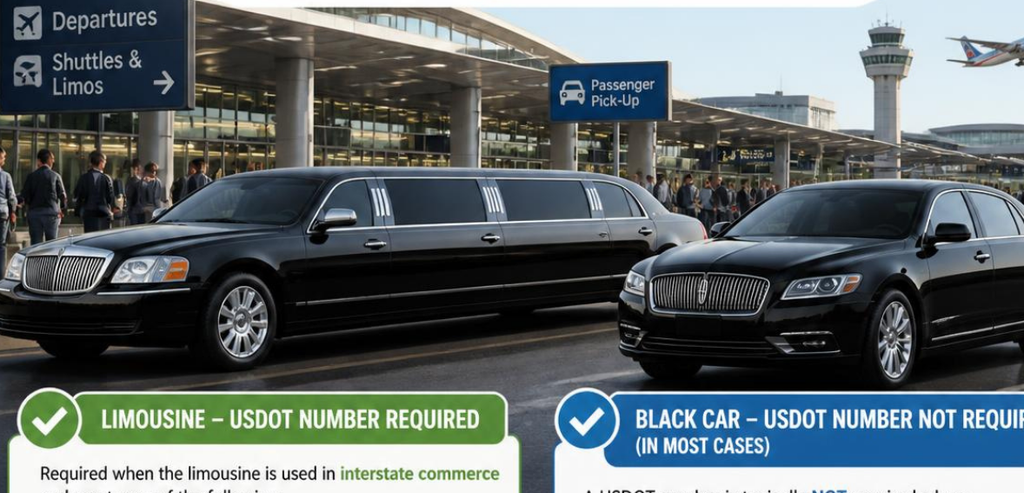
Most single-vehicle black car and sedan services do not need a USDOT number. Most stretch limos, vans, and party buses that cross state lines do. The dividing line comes down to two things: passenger capacity and where you drive.
If your vehicle seats eight or fewer people and you never cross state lines, you are usually outside federal jurisdiction. Push past eight passengers, or start driving across state borders, and the picture changes quickly. Let’s walk through the exact thresholds so you can place your own fleet.
The Passenger Count Rule Every Operator Must Know
Federal law establishes specific seating-capacity thresholds that all include the driver. This can be confusing to new owners, so it is important to remember that seating capacity always includes the driver.
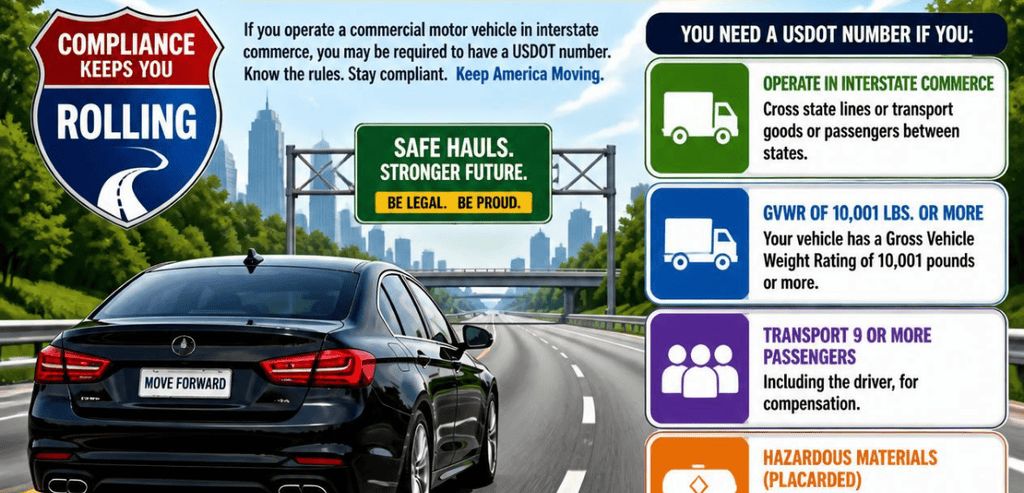
You must obtain a USDOT number when an owner operates a vehicle for compensation that is used to transport from 9 to 15 passengers (including the driver) and operates in interstate commerce. Compensation can be direct or indirect. The passenger’s fare may be paid by a third party, and in such cases, the owner is still required to obtain a USDOT number. This provision applies to a large part of the luxury transportation industry that includes stretch limousines and executive transportation vans.
There is also a not-for-compensation provision for vehicle transport that is designed to carry 16 or more passengers (including the driver). Large party buses and large shuttle-style limousines also require a USDOT number to operate in interstate commerce.
There is also an interstate commerce provision based on vehicle weight. A USDOT number is required to operate in interstate commerce when the vehicle has a gross vehicle weight rating of 10,001 pounds or more. This includes large coaches and large limo buses.
Interstate vs. Intrastate: The Line That Changes Everything
This is the concept that decides your fate. Interstate commerce means transportation that crosses state lines. It also includes trips that stay within one state but form part of a longer journey beginning or ending in another state. Intrastate commerce means the trip starts and ends inside a single state, with no interstate leg.
Here is why it matters. USDOT regulations pertain to interstate commerce. For example, a limo transporting clients from New Jersey to New York City is operating in interstate commerce. Conversely, a black car transporting a passenger within New York from a hotel to JFK is operating in intrastate commerce.
The term interstate is somewhat deceptive. For example, let’s say you pick up someone from an airport, and they just arrived from another state. If that trip is booked as a part of that same journey, that trip could be considered interstate, even if you never leave the state. If you are uncertain, address cross-border and connecting airport work as interstate and verify with the regulating authorities.
When Black Car and Sedan Operators Are Usually Exempt
Standard black car service runs on sedans and small SUVs. These vehicles typically seat far fewer than nine passengers. If that describes your fleet and you operate entirely within one state, federal registration usually does not apply to you.
A federal taxi-style exemption does exist. This model essentially means an operation providing transport similar to a taxi, with fewer than seven seats, is not run on a schedule or between predetermined stops, and is not subject to certain federal financial responsibility requirements. Many of the smaller black car businesses operate on a model very similar to this. However, just because federal law does not apply, that does not mean state law does not apply. For-hire transport regulations may be applied by your local authority regardless of the size of the vehicle.
When a Stretch Limo, Sprinter, or Party Bus Triggers Registration
The luxury vehicles that pack in more seats are where registration usually kicks in. A classic stretch limousine often seats 10 to 14 passengers. A Mercedes Sprinter limo can hold a dozen or more. Party buses routinely blow past 16. Any of these, running interstate work, will almost certainly need a USDOT number under the passenger-count rules above.
Don’t forget the insurance factor. All for-hire interstate passenger transport carrying 15 or fewer seats (including the driver) must provide $1,500,000 in public liability insurance. Carriers of larger vehicles must provide even higher minimums. This means that the same seat capacity that determines your USDOT number determines your insurance minimum. These obligations go hand in hand.
State Rules Can Override the Federal Exemption
Even with clearance from FMCSA, your state may have different rules. More states have recently begun requiring a USDOT number for intrastate commercial activity. Whereas the federal bar may be different, a limo operator who never leaves the state may be required to register under state law.
Checking only federal law and ignoring state law is the single most common mistake new operators make. A state inspector can flag you for an unregistered commercial vehicle. Before considering yourself exempt, make sure to check with your state Department of Transportation or Department of Motor Vehicles. Although the FMCSA’s small passenger-carrying vehicles guidance is a useful federal resource, your state has the authority to make rules for intrastate activity.
USDOT Number vs Operating Authority (MC Number)
New owners often confuse these two, and they are not the same thing. A USDOT number is your safety identifier. It tracks your compliance record. An MC number, or operating authority, is your legal permission to run as a for-hire carrier across state lines.
Here’s the practical breakdown. If you are transporting paying passengers across state lines, you are likely going to need both. You get the USDOT number for the safety oversight, and you secure the operating authority for the right to legally make interstate trips with paying passengers. Operators engaging in intrastate trips typically don’t have to deal with the federal operating authority, but they may need the USDOT number if it’s required by their state. The paperwork should match your operation, and not your competitor’s.
What Happens If You Skip Registration
Running without a required USDOT number is not a minor oversight. Penalties can reach well into the thousands of dollars per violation. Regulators can place your vehicle out of service on the spot. That means a stranded client, a refund, and a wrecked reputation.
In addition to penalties, you risk your insurance. Insurers may dispute claims after an accident involving an unauthorized carrier. There are also vehicle marking regulations. When you obtain a USDOT number, you must display your legal name and that number on both sides of the vehicle in accordance with federal regulations. There are no exceptions to marking. A roadside inspector will not hesitate to issue a citation.
How to Register the Right Way
To register, you need to go through FMCSA’s online process. First-time registrants will use the Unified Registration System instead of traditional paper forms. You will need to provide details regarding your operation, the number of vehicles you will be operating, and your vehicle’s passenger capacity. The USDOT number is free, but operating authority incurs a filing fee. Once you have operating authority, you will need to mark your vehicles, maintain your insurance, and keep your records updated.
Conclusion
So, does a limo company need a DOT number? For a small black car service running sedans within one state, often not at the federal level, though your state may still require it. For stretch limos, Sprinter vans, and party buses crossing state lines with nine or more seats, the answer is almost always yes. The two questions that decide everything are how many passengers your vehicle holds and whether your work crosses state lines.
Get this right before your first interstate booking, not after an inspection. Confirm your passenger count, map your routes, and call your state DOT to close any gaps. A little research now protects your business, your clients, and your bottom line for years to come.
Frequently Asked Questions (FAQs)
Does a black car service with only sedans need a USDOT number?
Usually not at the federal level, because sedans seat fewer than nine passengers. If you operate entirely within one state, you are typically exempt from federal rules. But several states require intrastate commercial carriers to register anyway, so always confirm with your state DOT.
My stretch limo seats 12. Do I need to register?
If you carry those passengers for compensation and cross state lines, yes. A vehicle designed to transport 9 to 15 passengers, including the driver, for pay in interstate commerce needs a USDOT number. You will likely need operating authority and $1.5 million in liability insurance as well.
What is the difference between a USDOT number and an MC number?
A USDOT number is your safety identifier used for inspections and compliance tracking. An MC number is your operating authority, meaning legal permission to carry paying passengers across state lines. Interstate for-hire limo operators generally need both.
Is a trip interstate if I never leave my state?
It can be. If your ride connects to a journey that begins or ends in another state, such as an airport pickup for an out-of-state traveler booked as one trip, it may count as interstate commerce. When unsure, treat connecting and cross-border work as interstate and verify with the FMCSA.